
Data center infrastructure, layer by layer.
Every facility is built from the same twelve layers, from the power chain at the base to compliance at the top. Here's how each one works, how to size it, which brands earn their place in Indian conditions, and how it changes with scale.
U01 Layer 1 of 12
Power: power that never blinks.
Everything else in a data center depends on this layer. It has one job: deliver clean, continuous electricity no matter what the grid does. In India, where utility supply carries frequent dips, spikes and outages, that job is harder than the textbooks assume.
A well-designed power system conditions incoming power so equipment sees a clean waveform, bridges outages instantly so nothing reboots, and scales with redundancy so a single failure never reaches the IT load.
The power chain
- Utility feed and transformer bring HT supply in and step it down.
- LT/MV switchgear and DB panels distribute and protect circuits.
- Servo stabiliser and isolation transformer regulate voltage and isolate the load.
- UPS and batteries bridge the gap until the generator starts.
- Diesel generator is the true primary source for extended outages.
- ATS/STS switch cleanly between sources without dropping load.
- PDUs and busway carry power to the rows and into each rack.
UPS systems
The UPS carries the load from batteries the instant utility fails, with zero interruption, until the generator takes over. For critical loads, online double-conversion topology continuously rebuilds the waveform for the cleanest, most protective output.
Li-ion or VRLA? VRLA is cheaper upfront but bulkier and shorter-lived. Lithium-ion costs more initially but saves floor space, lasts two to three times longer and tolerates higher temperatures. It is increasingly the default for new builds.
Diesel generators
In Indian conditions the generator is the dependable primary source for any outage longer than the battery runtime. A properly specified DG covers the full facility load (IT plus cooling) with margin, starts automatically via an AMF panel, carries a day-tank for fuel autonomy and, at scale, synchronises multiple units for load-sharing and redundancy.
The India-specific layer
This is where power design in India diverges most from Western references. Three categories address wide grid voltage swings and power-factor penalties:
- Servo stabilisers (AVR) continuously correct voltage to a safe band.
- Isolation transformers provide galvanic isolation that blocks grid-borne noise.
- APFC panels and harmonic filters correct power factor and clean harmonics.
Sizing basics
- UPS (kVA)
- IT load (kW) ÷ 0.9, plus 25% headroom, × redundancy factor
- DG set (kVA)
- Total facility load (IT × PUE ≈ 1.5) ÷ 0.8, with margin
- Battery
- 5–15 minutes of autonomy at full load
Brands we specify and supply
- UPS
- Vertiv (Liebert), Schneider (APC), Eaton, ABB, Delta, Riello, Socomec, Legrand/Numeric, Huawei
- Generators
- Cummins, Caterpillar, Kohler, Kirloskar (KOEL Green), Mahindra Powerol, Perkins, Sudhir Power, Greaves
- Power conditioning
- Servomax, Servokon, Kotson, Purevolt, Bhavani, Automatic Electric; Schneider, ABB, L&T, EPCOS/TDK, Neptune, Shreem
How it scales
- Small
- Single UPS with batteries, small DG, stabiliser and isolation transformer.
- Medium
- Modular UPS bank in N+1, synchronised DG, APFC and harmonic filtering.
- Large
- MV distribution, 2N UPS paths, multi-DG plant with load-sharing.
Power: frequently asked
What power equipment does a data center need?
An incoming transformer and switchgear, a UPS with batteries, one or more diesel generators, transfer switches, floor and rack PDUs, and, in India, isolation transformers, servo stabilisers and power-factor correction.
How do I size a UPS for a data center?
Convert IT load in kW to kVA using a power factor of about 0.9, add about 25% headroom, then apply redundancy. A 100 kW IT load points to roughly a 140 kVA UPS before redundancy.
Do I really need a servo stabiliser?
In most Indian small and medium sites, yes. Larger sites may condition power upstream at the MV stage instead.
U02 Layer 2 of 12
Precision cooling: heat is the enemy. Precision is the answer.
Servers turn every watt of power into heat. Removing it efficiently and reliably in India's climate is what precision cooling does, and getting it wrong is the fastest way to throttle or kill your IT.
A server rack can dissipate as much heat as a small oven, continuously. Comfort air conditioning is designed for people: it strips out too much humidity, isn't rated for continuous high-sensible-heat loads, and fails under data center density. Precision cooling holds tight temperature and humidity around the clock. In India, high ambient temperatures, humidity and dust all work against you, so capacity and filtration need real margin.
Cooling approaches
- CRAC / CRAH: room-level precision units, the workhorse of most facilities.
- In-row cooling: units between racks for higher, targeted density.
- Rear-door heat exchangers: cooling at the back of the rack itself.
- Chilled-water plant: chillers and cooling towers for large facilities.
- Liquid and immersion cooling: essential for dense AI and GPU deployments.
Containment beats brute tonnage
The biggest efficiency win isn't more cooling; it's better airflow. Hot and cold aisle containment stops hot exhaust mixing with cold supply, so every unit of cooling does more work. With blanking panels and good floor management, containment lowers PUE and lets you run fewer, smaller units.
Cooling for AI and high density
GPU and AI workloads pack far more power and heat into each rack than traditional IT. Beyond a certain density, air alone can't keep up, which is why direct-to-chip and immersion liquid cooling are moving into the mainstream. If AI is on your roadmap, design for it now.
Sizing basics
- Heat load
- ≈ IT load in kW (1 kW of power ≈ 1 kW of heat)
- Cooling (TR)
- IT load (kW) ÷ 3.517, plus about 25% margin
- Redundancy
- N+1 so a unit can fail or be serviced without overheating
Brands we specify and supply
- Precision cooling
- Vertiv (Liebert), Schneider (Uniflair), Stulz, Blue Star, Daikin, Carrier, Trane, Climaveneta
- Liquid / immersion
- Vertiv, Submer, GRC, Iceotope
How it scales
- Small
- Precision AC or DX CRAC units, basic hot/cold aisle layout.
- Medium
- CRAC/CRAH with full aisle containment and N+1 units.
- Large
- Chilled-water plant, in-row or rear-door units, liquid cooling for AI halls.
Precision cooling: frequently asked
Can a normal AC cool a server room?
No. Comfort AC removes too much humidity and isn't rated for continuous high-sensible-heat loads. Data centers need precision (CRAC/CRAH) cooling.
What is a good PUE?
Real facilities run roughly 1.4 to 2.0. Lower is better; containment and right-sizing are the main levers to improve it.
When do I need liquid cooling?
When rack density climbs into the range typical of GPU and AI clusters, air cooling struggles and direct-to-chip or immersion cooling becomes necessary.
Discuss your precision cooling requirementBack to the layer index
U03 Layer 3 of 12
Racks and enclosures: the frame that holds it all together.
Racks look simple, but they set the airflow, weight, cabling and containment strategy for the entire room. Cheap to get wrong, expensive to redo once populated.
Every other layer converges at the rack: power arrives through rack PDUs, cooling is directed by containment, cabling is dressed into the cabinet, and the IT is mounted in rack units (U). Decisions made here ripple across the whole facility.
What to specify
- Height: 42U is standard; 45U and 48U add density where ceiling height allows.
- Weight rating: loaded racks are heavy; static and dynamic ratings matter.
- Airflow: perforated doors and correct front-to-back airflow are essential.
- Depth and width: deep servers and side cable management need the right dimensions.
- Containment-ready: plan rows for hot/cold aisle containment from day one.
Rack PDUs and cable management
Inside each rack, rack PDUs distribute power to equipment. Metered and switched versions let you monitor and control consumption per outlet, which is vital for capacity planning and colocation billing. Good vertical and horizontal cable management keeps airflow clear and maintenance sane.
Brands we specify and supply
- Racks and PDUs
- Rittal, Schneider (APC), Vertiv, Legrand, Eaton, Netrack, Valrack
How it scales
- Small
- A handful of standalone 42U cabinets, basic PDUs.
- Medium
- Rows of racks with containment and metered PDUs.
- Large
- Standardised rows, full containment, switched PDUs integrated with DCIM.
Racks and enclosures: frequently asked
42U, 45U or 48U: which rack height should I choose?
42U is the safe standard. Go higher only if ceiling height, floor loading and cooling airflow all support the extra density.
Do I need metered rack PDUs?
For capacity planning or colocation billing, yes. Per-rack or per-outlet power visibility is extremely valuable.
Can I add aisle containment later?
You can, but it's far cheaper and cleaner to plan rows for containment from the start.
Discuss your racks and enclosures requirementBack to the layer index
U04 Layer 4 of 12
Structured cabling: the nervous system of the facility.
Copper and fibre carry every bit in and out of your data center. Structured cabling is invisible when done well, and a nightmare to fix once the racks are full.
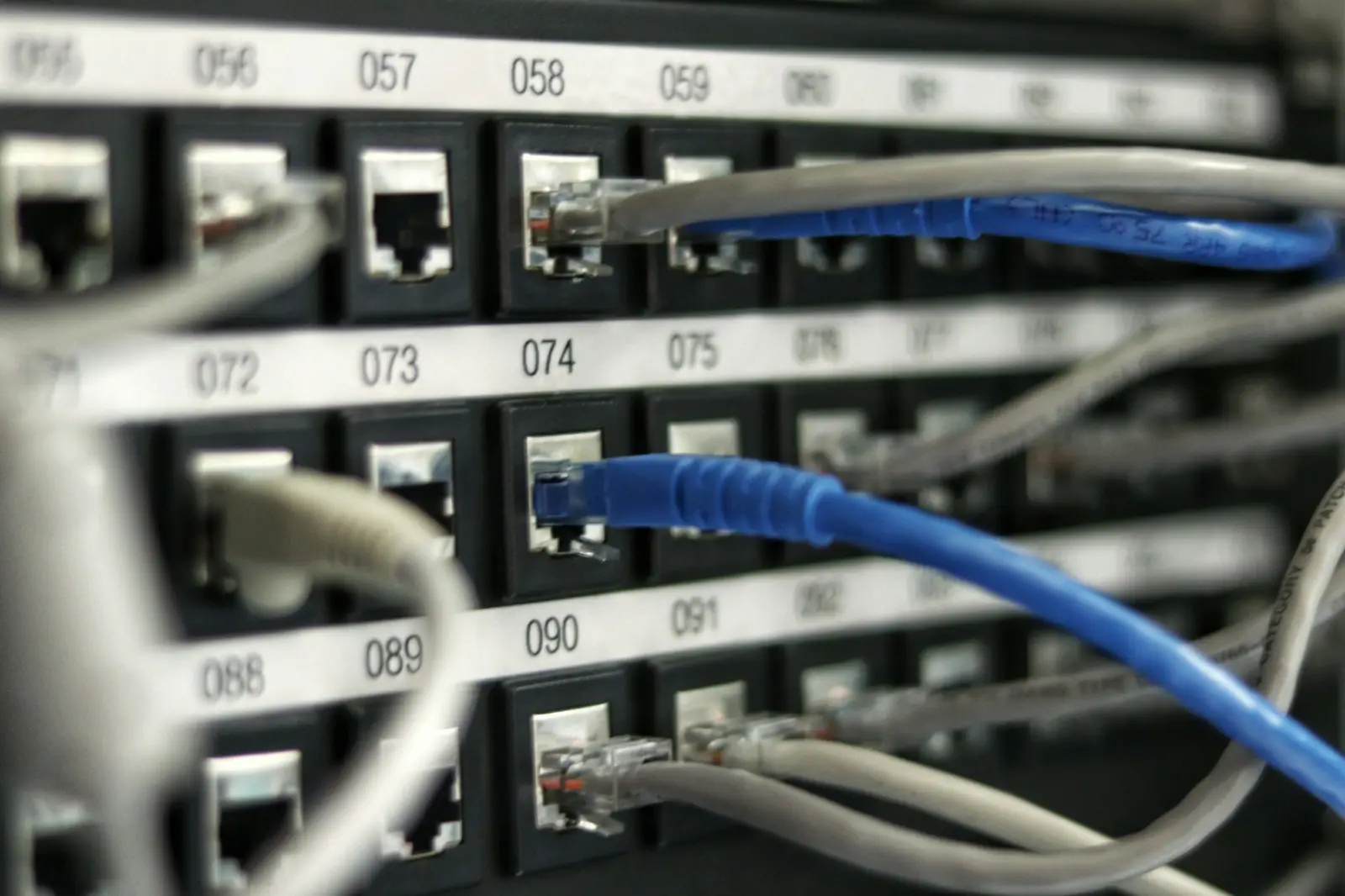
Done properly, structured cabling is tidy, labelled, documented and future-proof. Done poorly, it becomes a tangle that blocks airflow, slows every change and hides faults.
Copper and fibre
- Cat6A copper: the practical standard for in-rack and short server links.
- OM4 / OS2 fibre: for the backbone, high-speed links and any distance.
- Spine-leaf backbone: the modern topology that fibre makes possible at scale.
Almost every facility runs both: copper to the servers, fibre for the backbone.
Trays, patching and the meet-me room
Cable trays and ladders route bundles overhead or under floor, patch panels make moves and changes manageable, and the meet-me room (MMR) is where carrier fibre enters and cross-connects happen: the doorway between your facility and the outside network.
Brands we specify and supply
- Cabling
- CommScope (Systimax), Belden, Panduit, Legrand, Molex, R&M, Corning, STL, D-Link
How it scales
- Small
- Basic Cat6A, in-rack patching, minimal fibre.
- Medium
- Structured copper plus fibre backbone, patch panels, labelled and documented.
- Large
- Fibre spine-leaf, high-density patching, formal MMR and carrier cross-connects.
Structured cabling: frequently asked
Copper or fibre for a data center?
Both. Cat6A copper for server links, OM4/OS2 fibre for the backbone and any long-distance or high-speed link.
Why does cable labelling matter so much?
Undocumented cabling turns every future change into detective work. Labelling and records save enormous time and risk.
What is a meet-me room?
The space where external carrier fibre enters the facility and cross-connects to your network: the boundary between you and the outside world.
Discuss your structured cabling requirementBack to the layer index
U05 Layer 5 of 12
Compute, storage and network: the workload the whole building serves.
Everything else exists to keep this layer running: the servers, storage and network that actually do the work. Here's how the pieces fit, and where AI is changing the rules.
How you specify this layer depends entirely on the workload. A virtualisation cluster, a storage-heavy archive and an AI training farm have very different needs.
Compute and AI
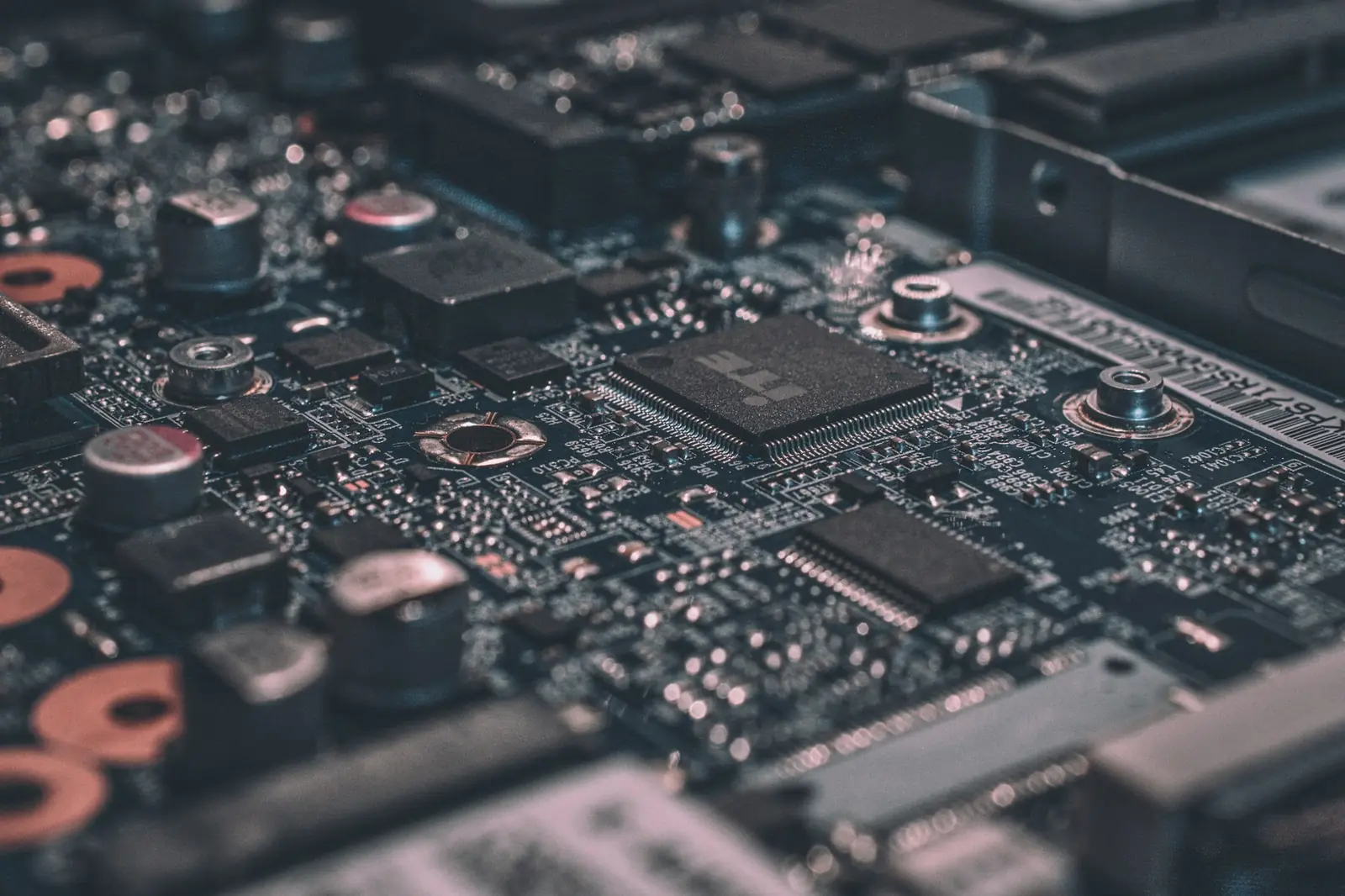
Servers come as rack-mount, blade or hyperconverged nodes. The big shift is AI: GPU servers draw far more power and heat per rack than traditional compute, which forces changes in power density and cooling. Planning IT and facility layers together is now essential.
Storage and network
Storage ranges from all-flash arrays for performance to high-capacity systems for archives. Networking (switches, routers, firewalls and load balancers) ties it together and to the outside world, with security appliances guarding the perimeter.
Brands we specify and supply
- Compute
- Dell, HPE, Lenovo, Cisco UCS, Supermicro, IBM, Huawei
- AI / GPU
- NVIDIA (DGX), Supermicro, Dell, HPE
- Storage
- Dell, NetApp, HPE, Pure Storage, Hitachi Vantara, IBM
- Network
- Cisco, Juniper, Arista, HPE Aruba, Huawei, Extreme
- Security and access
- Palo Alto, Fortinet, Check Point (firewalls); F5, Citrix (load balancers); Raritan, Vertiv/Avocent, ATEN (KVM)
How it scales
- Small
- A few servers, simple storage, a single switch pair.
- Medium
- Virtualised clusters, shared storage, redundant network fabric.
- Large
- Large clusters, GPU farms, spine-leaf fabric, dedicated storage tiers.
Compute, storage and network: frequently asked
Does SNA Power supply the IT hardware too?
We advise on and can supply across the stack, and design the facility layers to match the IT you plan to run.
How does AI change data center design?
GPU and AI systems dramatically raise power density and heat, which reshapes power and cooling design. It is best planned from the start.
What is a KVM used for?
Keyboard-video-mouse and console access lets administrators reach servers directly, including remotely over IP, without a monitor per machine.
Discuss your compute, storage and network requirementBack to the layer index
U06 Layer 6 of 12
Fire detection and suppression: catch it early. Put it out cleanly.
A fire in a data center is catastrophic, and water makes it worse. This layer detects trouble before it's visible and suppresses it without destroying the equipment you're protecting.
You can't use water sprinklers over live IT, and by the time a normal detector triggers, damage is done. Data center fire protection is built around very early detection and clean, non-destructive suppression.
Early detection with VESDA
VESDA (Very Early Smoke Detection Apparatus) is an aspirating system that continuously samples the air and detects the earliest particles of overheating, long before smoke is visible. That head start is often enough to intervene before suppression is needed.
Clean-agent suppression
When suppression is required, data centers use gaseous clean agents, never water. Agents such as Novec 1230, FM-200 or inert gases flood the space and extinguish fire without residue or harm to electronics or people at design concentrations.
Brands we specify and supply
- Fire systems
- Honeywell (Xtralis VESDA / Notifier), Siemens, Tyco, Kidde, Ceasefire, Bosch
How it scales
- Small
- Single-zone detection and suppression with an alarm panel.
- Medium
- VESDA plus zoned clean-agent suppression.
- Large
- Multi-zone VESDA, cross-zoned suppression, full BMS integration.
Fire detection and suppression: frequently asked
Why not use water sprinklers in a data center?
Water destroys energised electronics. Data centers use gaseous clean agents that suppress fire without residue or equipment damage.
What is VESDA?
An aspirating smoke detection system that samples air continuously and detects overheating at the earliest stage, before visible smoke.
Are clean agents safe for people?
At design concentrations, agents such as Novec 1230 and inert gases are safe for occupied spaces, with appropriate warning and egress design.
Discuss your fire detection and suppression requirementBack to the layer index
U07 Layer 7 of 12
Physical security: who gets in, and who is watching.
A data center is a physical building full of valuable, sensitive equipment. This layer controls who reaches it, down to the individual rack.
Good physical security works in concentric rings: perimeter, building, white space, and finally the rack. Each ring adds a control, so a breach at one level still meets another. For colocation, control down to the individual cabinet is a core requirement.
Access control
Access control decides who passes each ring using cards, PINs and increasingly biometrics. A mantrap (an interlocked two-door vestibule) prevents tailgating into the white space, and rack-level locks restrict who can open which cabinet.
Surveillance
CCTV provides continuous recorded coverage of entrances, aisles and equipment, tied into access and alarm systems so events can be reviewed and correlated. Retention and coverage are often set by compliance requirements.
Brands we specify and supply
- Access control
- Honeywell, HID, Bosch, Matrix, ZKTeco
- CCTV
- Hikvision, Axis, Bosch, CP Plus, Dahua
How it scales
- Small
- Door access control and basic CCTV.
- Medium
- Multi-zone access, mantrap, comprehensive CCTV, visitor management.
- Large
- Perimeter security, rack-level access, BMS integration and audit logging.
Physical security: frequently asked
What is a mantrap?
An interlocked two-door vestibule that only opens one door at a time, preventing tailgating into secure areas.
Do I need rack-level access control?
For colocation and multi-tenant environments, yes. It ensures each client can reach only their own equipment.
How long should CCTV footage be retained?
It varies by policy and compliance regime; many enterprises retain footage for weeks to months.
Discuss your physical security requirementBack to the layer index
U08 Layer 8 of 12
DCIM and monitoring: you can't run what you can't see.
A data center generates thousands of data points a second. DCIM and BMS bring them into one view so problems surface before they become outages.
DCIM (Data Center Infrastructure Management) tracks power, cooling, space and capacity. The BMS (Building Management System) runs the facility's mechanical and electrical plant. Together they turn raw signals into alerts, trends and decisions.
DCIM and BMS
DCIM answers questions like how much power and cooling capacity is left, where a rack is running hot, and how full the room is. BMS controls and monitors cooling plant, generators, fire and access systems. The most effective facilities integrate the two rather than running them as silos.
Sensors and leak detection
Underneath sits a mesh of sensors: temperature and humidity across the room, power metering per rack, and crucially water-leak detection under floors and around cooling plant, because a small leak near live power is a serious hazard.
Brands we specify and supply
- DCIM
- Schneider EcoStruxure, Vertiv (Environet / Trellis), Nlyte, Sunbird
- BMS
- Honeywell, Siemens, Johnson Controls, Schneider
- Leak detection
- RLE, TTK
How it scales
- Small
- Environmental sensors and basic alerting.
- Medium
- DCIM for capacity and power, integrated leak and thermal sensing.
- Large
- Full DCIM and BMS integration, predictive analytics, single pane of glass.
DCIM and monitoring: frequently asked
What's the difference between DCIM and BMS?
DCIM focuses on IT infrastructure: power, cooling and capacity of the white space. BMS runs the building's mechanical and electrical plant. They work best integrated.
Why is leak detection important in a data center?
Cooling systems carry water near live electrical equipment. Early leak detection stops a small drip becoming a major incident.
Can monitoring reduce data center running costs?
Yes. Capacity visibility avoids over-building, and thermal data helps optimise cooling and lower PUE.
Discuss your dcim and monitoring requirementBack to the layer index
U09 Layer 9 of 12
Civil and building: the shell that makes it a data center.
Before any equipment arrives, the room itself has to be right: the floor, the walls, the fire rating, the structure. Every other layer depends on it.
A data center's shell manages airflow, contains fire, carries heavy loads, keeps out dust and water, and defines the security perimeter. Getting civil works right early prevents expensive rework once the room is live.
Flooring and structure
Raised access flooring traditionally delivers under-floor cooling and cabling, though many modern builds route overhead instead. It's a design choice driven by cooling strategy, not a mandatory item. Either way, structural reinforcement matters: loaded racks and heavy plant (UPS, batteries, DG) impose serious floor loads.
Partitions, fire rating and sealing
DC-grade partitions and fire-rated walls compartmentalise the facility so a fire or breach is contained. Vapour barriers and sealed penetrations keep out humidity and dust, a bigger concern in Indian conditions than many designs allow for.
Brands we specify and supply
- Access flooring
- Tate, Kingspan / Unitile, ASM Modular, Netfloor, Pelican
- Partitions and insulation
- Lindner, Rockwool, Saint-Gobain
How it scales
- Small
- Often overhead cabling, no raised floor, basic fire-rated partitions.
- Medium
- Purpose-built room with containment-ready structure.
- Large
- Purpose-built building or campus with full containment architecture.
Civil and building: frequently asked
Is a raised floor mandatory in a data center?
No. It's a design choice tied to your cooling and cabling strategy. Many modern builds use overhead routing instead.
Why does floor loading matter?
Racks, UPS, batteries and generators are extremely heavy; the structure must be rated for concentrated loads.
How does the building affect cooling?
Sealing, insulation and a containment-ready layout directly affect cooling efficiency and PUE.
Discuss your civil and building requirementBack to the layer index
U10 Layer 10 of 12
Ancillary systems: the small systems that prevent big failures.
Leak detection, pest control, lighting, plumbing, labelling: none of it is glamorous, and all of it can take a facility down if ignored.
Ask any seasoned operator about their worst incidents and a surprising number trace back to ancillary systems: a rodent through a cable, a leak under the floor, a mislabelled circuit pulled by mistake. These systems are cheap relative to the risk they retire.
What's in this layer
- Water-leak detection: rope and spot sensors under floors and around cooling.
- Pest and rodent control: ultrasonic repellent, anti-termite treatment, sealed cable entries and integrated pest management.
- Lighting: efficient LED with emergency and egress lighting.
- Plumbing: for cooling and humidification, kept away from live power.
- Labelling and documentation: every circuit, cable and rack identified.
Brands we specify and supply
- Ancillary
- RLE, TTK (leak detection); Rentokil, Pest Control India (IPM); Philips, Wipro Lighting
How it scales
- Small
- Leak sensors, rodent repellent, emergency lighting.
- Medium
- Zoned leak detection, integrated pest management, full labelling.
- Large
- BMS-linked leak detection, formal IPM programme, everything documented.
Ancillary systems: frequently asked
Is pest control really necessary in a data center?
Yes. Rodents chewing cables are a genuine and recurring cause of outages, especially in Indian conditions. Prevention is cheap insurance.
Where should leak detection go?
Under raised floors and around any water-bearing plant such as cooling units and humidifiers.
Why obsess over labelling?
Unlabelled infrastructure causes accidental outages and slows every change and repair.
Discuss your ancillary systems requirementBack to the layer index
U11 Layer 11 of 12
Software and platform: turning hardware into a service.
Racks of servers are just metal until software makes them useful. Virtualisation, backup and cloud integration turn raw infrastructure into resilient, recoverable platforms.
The physical layers keep the lights on; the software layer decides how efficiently and safely workloads run on top.
Virtualisation and platform
Virtualisation and hyperconverged platforms let many workloads share hardware safely, improving utilisation and enabling rapid recovery. Hybrid and multi-cloud strategies place workloads where they run best: on-prem for latency and data localisation, cloud for burst and reach.
Backup and disaster recovery
Good backup design keeps multiple copies in separate locations with tested restore procedures, because a backup you've never restored is only a hope. For Indian enterprises, DR site strategy also intersects with data-localisation rules.
Brands we specify and supply
- Virtualisation
- VMware, Nutanix, Microsoft Hyper-V, Citrix
- Cloud
- AWS, Azure, Google Cloud
- Backup
- Veeam, Commvault, Veritas
How it scales
- Small
- Single virtualisation host, basic backup.
- Medium
- Clustered virtualisation, scheduled backup, cloud integration.
- Large
- Full platform automation, orchestrated DR site, multi-cloud.
Software and platform: frequently asked
Do I still need an on-prem data center if I use cloud?
Most Indian enterprises run hybrid. Latency, cost at scale and data localisation keep on-prem and colocation relevant alongside cloud.
What makes a good backup strategy?
Multiple copies, kept in separate locations, with regularly tested restores. An untested backup is not a backup.
How does virtualisation help resilience?
It decouples workloads from specific hardware, enabling rapid migration and recovery when a host fails.
Discuss your software and platform requirementBack to the layer index
U12 Layer 12 of 12
Compliance and standards: the certifications that earn trust.
For enterprise and BFSI clients, a data center is only as good as the standards it meets. Compliance is what lets serious customers trust a facility with their workloads.
Certification signals that design, resilience and operations meet an independently recognised bar. It is far cheaper to design compliance in from the start than to retrofit it under audit.
Uptime Tiers and TIA-942
The Uptime Institute Tiers (I–IV) classify resilience, from basic single-path to fully fault-tolerant. TIA-942 is the telecommunications infrastructure standard covering cabling, architecture and more. Together they define what good looks like physically. See the full Tier comparison.
ISO, BIS and India-specific rules
Management standards such as ISO 27001 (information security) and ISO 50001 (energy) govern how the facility is run. In India, MeitY guidelines, data-localisation rules and sector norms such as RBI requirements for BFSI increasingly shape where and how data must be held, and are a major driver of new-build demand.
How it scales
- Small
- Local fire and electrical NOCs, security basics.
- Medium
- ISO 27001, TIA-942 alignment, sector compliance.
- Large
- Tier III/IV certification, full ISO suite, audited operations.
Compliance and standards: frequently asked
Does a Tier IV data center require two utility feeds?
No. Tier IV requires two independent, simultaneously active distribution paths, not two utility sources. Generators are the recognised primary source.
Which data center certifications do I actually need?
It depends on your clients and sector. BFSI and enterprise typically expect ISO 27001 and a Tier III design; localisation rules may add more.
Why design compliance in early?
Certification requirements touch power, cooling, security and monitoring. Retrofitting them after build is far more expensive.
Discuss your compliance and standards requirementBack to the layer index
Planning one layer, or all twelve?
From a single server room to a megawatt build, we design, specify and deliver infrastructure that fits your scale and Indian conditions.